Home Environment research
Cooling coverage basics
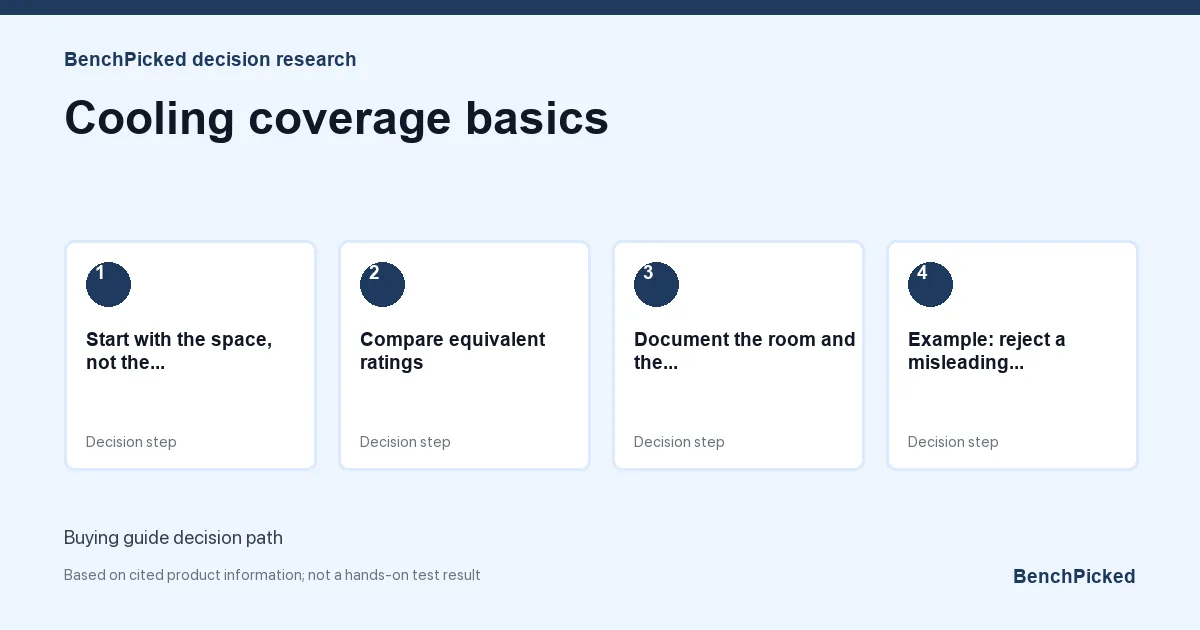
Start with the space, not the advertised maximum. Compare equivalent ratings. Document the room and the stated test boundary. Example: reject a misleading room-size comparison.
Written by BenchPicked Editorial Team · Sources checked Sep 15, 2026
Decision answer
Bottom line
Measure the floor area and note ceiling height, sun exposure and connected spaces. ENERGY STAR recommends matching room air conditioner capacity to the room; an oversized unit can cool before removing enough humidity. Its sizing guidance concerns room air conditioners, not a promise about a personal water-fed cooler.
- For
- people choosing a cooling or comfort product for a specific room
- Decision
- use cooling coverage basics to make a product decision without overreading promotional claims
- Context
- checking the cooling mechanism, room conditions, installation, noise and running cost
Decision matrix
Read each published value in the context of the decision it can actually support.
| Factor | Published information | How to use it |
|---|---|---|
| Start with the space, not the advertised maximum | Measure the floor area and note ceiling height, sun exposure and connected spaces. ENERGY STAR recommends matching room air conditioner capacity to the room; an oversized unit can cool before removing enough humidity. Its sizing guidance concerns room air conditioners, not a promise about a personal water-fed cooler. | Apply this step to the exact product, room, device or purchase terms being compared. |
| Compare equivalent ratings | Record the model, stated cooling capacity, coverage conditions and installation requirements. If a listing supplies only a room-size claim, ask which conditions produced it. Do not convert that claim into a measured cooling result. | Apply this step to the exact product, room, device or purchase terms being compared. |
| Document the room and the stated test boundary | Build a room record before comparing products: floor area, ceiling height, sun exposure, doorway position, insulation, humidity and the hours when cooling is needed. Then copy the exact capacity or coverage statement for each model with its units and conditions. Keep seller room-size language separate from a standardized cooling-capacity rating. If the page omits ambient temperature, humidity, airflow setting or test method, mark those conditions unknown. This prevents a precise-looking coverage number from being applied to a room or cooling mechanism it was never shown to represent. | Apply this step to the exact product, room, device or purchase terms being compared. |
| Example: reject a misleading room-size comparison | Suppose Product A publishes a standardized capacity and installation requirements, while Product B advertises up to 500 square feet but describes a small water-fed personal cooler. Do not rank B higher from the larger number. Record the mechanisms in separate columns, retain B's 500-square-foot statement as a seller claim, and ask for capacity, airflow and test conditions. Match A to the room using its documented rating and keep B conditional for localized use. The comparison can change when better evidence arrives, but it does not manufacture equivalence between unlike systems. | Apply this step to the exact product, room, device or purchase terms being compared. |
Claim and evidence record
contextual guidance
Measure the floor area and note ceiling height, sun exposure and connected spaces. ENERGY STAR recommends matching room air conditioner capacity to the room; an oversized unit can cool before removing enough humidity. Its sizing guidance concerns room air conditioners, not a promise about a personal water-fed cooler.
Apply the cited guidance to the exact product documentation; it is not a product-performance finding.
ENERGY STAR room air conditioner sizingWhen another option is the better fit
A room air conditioner
Choose this when documented cooling capacity and humidity control are required.
An evaporative cooler
Choose this when the climate is dry and added humidity is acceptable.
A circulation fan
Choose this when air movement, not temperature reduction, is the actual goal.
Product example
Apply these criteria to Glacier Breeze Portable AC
Use this approved product option as a concrete example while applying the criteria on this page. Confirm its published specifications and current seller terms before ordering.
Read the product researchSource notes
- ENERGY STAR Room Air Conditioner Sizing · Government · Checked Sep 15, 2026
- US Department Of Energy HVAC Guide · Government · Checked Sep 15, 2026
Questions
What should I record before comparing?
Floor area, ceiling height, sun exposure, ventilation and the intended operating period. Keep the product's published capacity and its test conditions alongside those notes.
Can the largest advertised room size decide the shortlist?
No. Compare the exact model, cooling mechanism, stated capacity and test conditions against the recorded room. Treat an unsupported maximum as seller language, not a measured result.
How should connected rooms or high ceilings be handled?
Record them as added load and uncertainty. Do not use floor area alone when air can escape into other spaces or the room volume differs substantially.
Before you buy
Recheck fit and current terms
Compare Glacier Breeze Portable AC with the criteria on this page, then confirm the current seller terms.
How BenchPicked separates published facts, analysis, and evidence limits