Home Environment research
Noise and room size tradeoffs
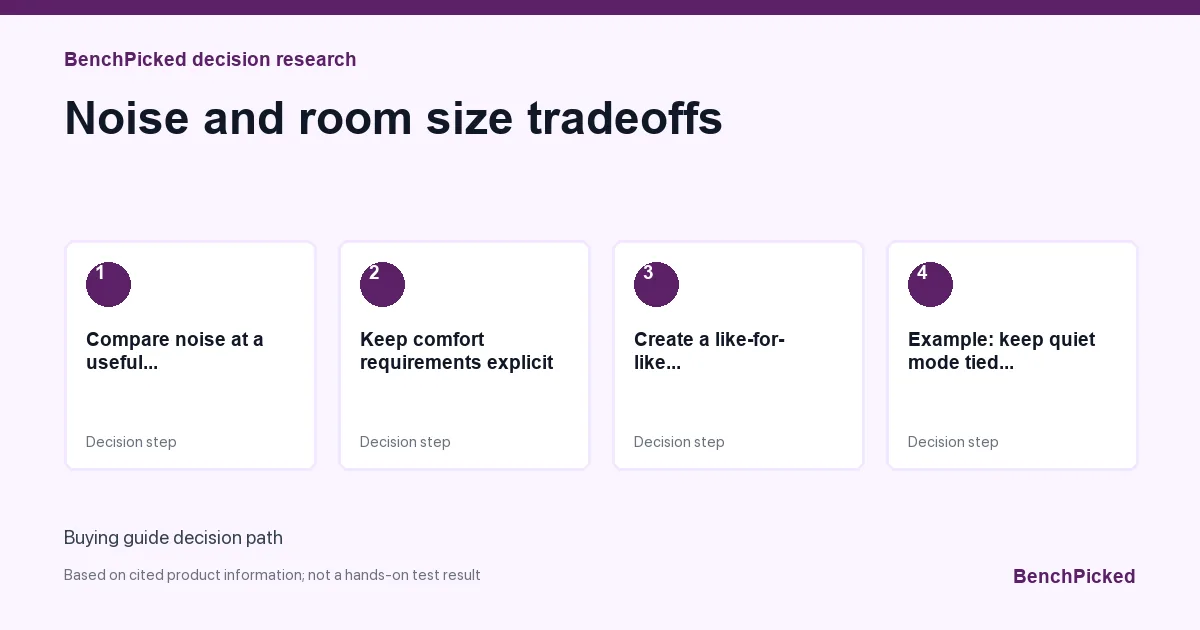
Compare noise at a useful operating setting. Keep comfort requirements explicit. Create a like-for-like operating scenario. Example: keep quiet mode tied to useful output.
Written by BenchPicked Editorial Team · Sources checked Sep 15, 2026
Decision answer
Bottom line
A quiet-mode description is not a room-cooling rating. For a practical comparison, record the published sound level, measurement distance and fan setting alongside the cooling specification. ENERGY STAR identifies low-noise models in its Most Efficient range, but that does not certify an unrelated seller's quietness claim.
- For
- people choosing a cooling or comfort product for a specific room
- Decision
- use noise and room size tradeoffs to make a product decision without overreading promotional claims
- Context
- checking the cooling mechanism, room conditions, installation, noise and running cost
Decision matrix
Read each published value in the context of the decision it can actually support.
| Factor | Published information | How to use it |
|---|---|---|
| Compare noise at a useful operating setting | A quiet-mode description is not a room-cooling rating. For a practical comparison, record the published sound level, measurement distance and fan setting alongside the cooling specification. ENERGY STAR identifies low-noise models in its Most Efficient range, but that does not certify an unrelated seller's quietness claim. | Apply this step to the exact product, room, device or purchase terms being compared. |
| Keep comfort requirements explicit | For a bedroom, decide when the device would run and how close it would sit. Ask whether the stated sound figure applies at the operating setting you need. If no comparable sound data is supplied, leave that comparison unresolved rather than assigning a noise score. | Apply this step to the exact product, room, device or purchase terms being compared. |
| Create a like-for-like operating scenario | Choose the room, distance from the listener, time of use and cooling demand before comparing noise. Record sound figures with their fan setting, measurement distance and test standard; figures without those conditions are not directly comparable. Then connect noise to capacity: a low setting may be quieter but may not deliver the airflow or cooling required for the room. Keep sleep or work preferences separate from measured sound data. When a model publishes no decibel value, mark it unknown and compare return terms or in-store demonstration options instead of inventing a quietness rank from reviews or marketing words. | Apply this step to the exact product, room, device or purchase terms being compared. |
| Example: keep quiet mode tied to useful output | Imagine Product A lists 48 dB on low and a documented capacity for the room, while Product B says whisper quiet without a level or setting. Record A's number with its mode and verify whether low can meet the required load. Mark B's sound level unknown and seek the manual or seller response. If nighttime use is decisive, compare both at the operating setting needed for that room and retain the return path as a practical uncertainty control. This avoids rewarding an unmeasured adjective or treating an unusably low setting as the answer. | Apply this step to the exact product, room, device or purchase terms being compared. |
Claim and evidence record
contextual guidance
A quiet-mode description is not a room-cooling rating. For a practical comparison, record the published sound level, measurement distance and fan setting alongside the cooling specification. ENERGY STAR identifies low-noise models in its Most Efficient range, but that does not certify an unrelated seller's quietness claim.
Apply the cited guidance to the exact product documentation; it is not a product-performance finding.
ENERGY STAR room air conditioner sizingWhen another option is the better fit
A room air conditioner
Choose this when documented cooling capacity and humidity control are required.
An evaporative cooler
Choose this when the climate is dry and added humidity is acceptable.
A circulation fan
Choose this when air movement, not temperature reduction, is the actual goal.
Product example
Apply these criteria to Glacier Breeze Portable AC
Use this approved product option as a concrete example while applying the criteria on this page. Confirm its published specifications and current seller terms before ordering.
Read the product researchSource notes
- ENERGY STAR Room Air Conditioner Sizing · Government · Checked Sep 15, 2026
- US Department Of Energy HVAC Guide · Government · Checked Sep 15, 2026
Questions
Does a quiet label tell me the sound level?
No numerical comparison can be made without a stated level and conditions. Ask for the model-specific documentation and compare like-for-like settings.
Can a sleep mode label be compared with a decibel figure?
Not by itself. A mode name gives no shared measurement condition. Use a model-specific sound level with setting and distance, or leave the comparison unresolved.
Why record distance from the device?
Sound exposure and perceived disturbance change with placement. A useful comparison keeps the same intended distance and operating demand for every candidate.
Before you buy
Recheck fit and current terms
Compare Glacier Breeze Portable AC with the criteria on this page, then confirm the current seller terms.
How BenchPicked separates published facts, analysis, and evidence limits