Home Environment research
Portable AC vs air cooler
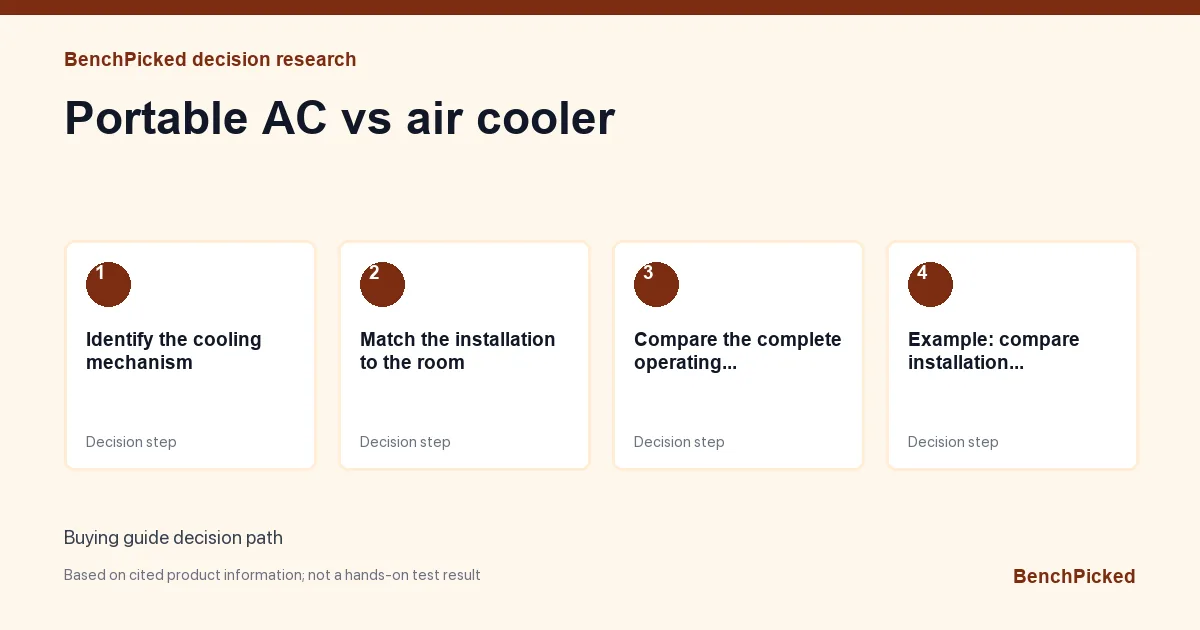
Identify the cooling mechanism. Match the installation to the room. Compare the complete operating system. Example: compare installation and climate before price.
Written by BenchPicked Editorial Team · Sources checked Sep 15, 2026
Decision answer
Bottom line
A product name containing AC does not explain how it cools. The Department of Energy distinguishes refrigerant-based cooling from evaporative systems. Direct evaporative cooling uses water evaporation and adds moisture; its suitability depends on climate. A small seller-described water-fed cartridge does not establish equivalent performance to a refrigerant air conditioner.
- For
- people choosing a cooling or comfort product for a specific room
- Decision
- use portable ac vs air cooler to make a product decision without overreading promotional claims
- Context
- checking the cooling mechanism, room conditions, installation, noise and running cost
Decision matrix
Read each published value in the context of the decision it can actually support.
| Factor | Published information | How to use it |
|---|---|---|
| Identify the cooling mechanism | A product name containing AC does not explain how it cools. The Department of Energy distinguishes refrigerant-based cooling from evaporative systems. Direct evaporative cooling uses water evaporation and adds moisture; its suitability depends on climate. A small seller-described water-fed cartridge does not establish equivalent performance to a refrigerant air conditioner. | Apply this step to the exact product, room, device or purchase terms being compared. |
| Match the installation to the room | Check whether the product needs an exhaust arrangement, a water supply or refilling, and routine cleaning. Ask for the actual manual rather than assuming that a product photo shows everything required. Compare running costs only when power and operating time are documented. | Apply this step to the exact product, room, device or purchase terms being compared. |
| Compare the complete operating system | List what each option needs to work: exhaust duct and window opening, refill water, drainage, filter care, electrical input and clearance around the unit. Record whether the exact model is refrigerant-based, evaporative or only circulates air. For evaporative equipment, climate and ventilation are decision inputs rather than footnotes because added humidity can change suitability. Compare delivered price and documented power use only after the mechanisms are separated. If a seller uses AC in a product name but publishes no refrigerant system or capacity, keep it in the air-cooler column until model-specific documentation says otherwise. | Apply this step to the exact product, room, device or purchase terms being compared. |
| Example: compare installation and climate before price | For a humid bedroom with a usable window, one candidate requires an exhaust hose and lists refrigerant cooling capacity; another uses a refillable water cartridge and has a lower purchase price. First check whether each mechanism fits the climate and installation. Then compare documented power, drainage or refill work, noise conditions and return terms. The cheaper device should not inherit the air conditioner's expected room result, and the air conditioner should not be penalized for installation effort that the room can accommodate. Price becomes meaningful only after both options are evaluated for the same job. | Apply this step to the exact product, room, device or purchase terms being compared. |
Claim and evidence record
contextual guidance
A product name containing AC does not explain how it cools. The Department of Energy distinguishes refrigerant-based cooling from evaporative systems. Direct evaporative cooling uses water evaporation and adds moisture; its suitability depends on climate. A small seller-described water-fed cartridge does not establish equivalent performance to a refrigerant air conditioner.
Apply the cited guidance to the exact product documentation; it is not a product-performance finding.
US Department of Energy HVAC guideWhen another option is the better fit
A room air conditioner
Choose this when documented cooling capacity and humidity control are required.
An evaporative cooler
Choose this when the climate is dry and added humidity is acceptable.
A circulation fan
Choose this when air movement, not temperature reduction, is the actual goal.
Product example
Apply these criteria to Glacier Breeze Portable AC
Use this approved product option as a concrete example while applying the criteria on this page. Confirm its published specifications and current seller terms before ordering.
Read the product researchSource notes
- US Department Of Energy HVAC Guide · Government · Checked Sep 15, 2026
- ENERGY STAR Room Air Conditioner Sizing · Government · Checked Sep 15, 2026
Questions
Can a water-fed cooler replace my air conditioner?
Do not assume equivalence. Identify the mechanism and obtain capacity and operating-condition information for the exact model before deciding whether it suits your room.
Does adding ice make an air cooler equivalent to an air conditioner?
No. Ice or chilled water does not establish refrigerant-based cooling capacity. Compare the documented mechanism and operating conditions for the exact models.
Which recurring tasks belong in the comparison?
Include refilling, drainage, filter or cartridge replacement, cleaning and seasonal storage, using published instructions and prices where available.
Before you buy
Recheck fit and current terms
Compare Glacier Breeze Portable AC with the criteria on this page, then confirm the current seller terms.
How BenchPicked separates published facts, analysis, and evidence limits