Household Gadgets research
Household gadget buying criteria
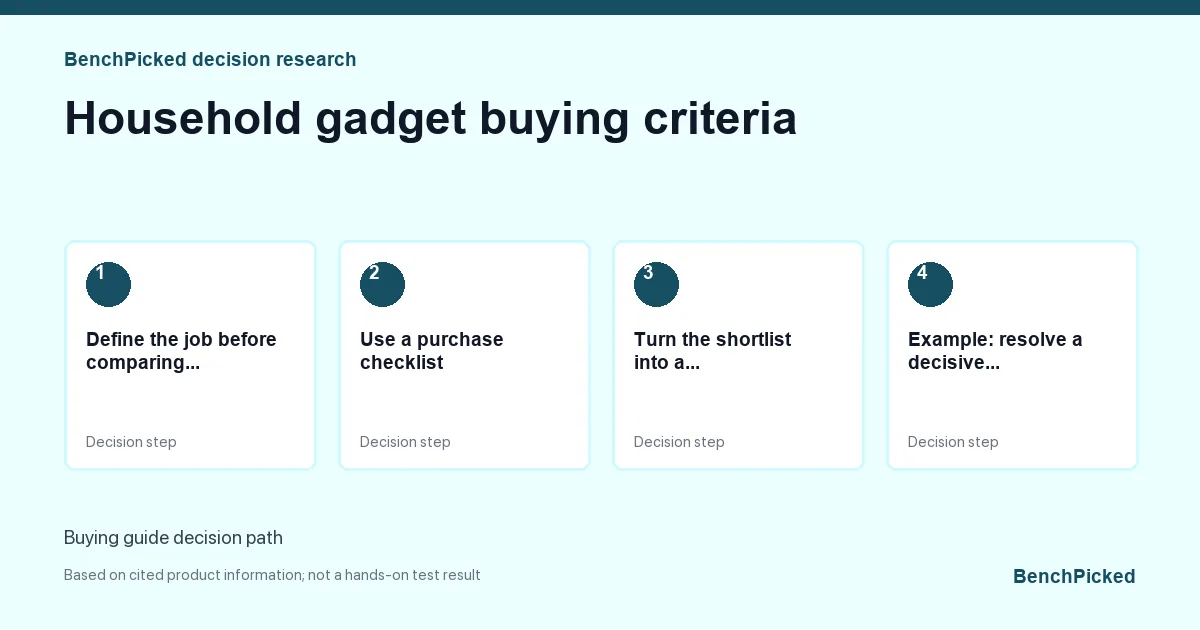
Define the job before comparing the offer. Use a purchase checklist. Turn the shortlist into a decision record. Example: resolve a decisive unknown before ranking.
Written by BenchPicked Editorial Team · Sources checked Sep 15, 2026
Decision answer
Bottom line
Write down the task, installation location and compatibility constraints. The FTC advises checking the seller and product rather than relying on star ratings alone. A promotional page can describe an offer without providing independent evidence that it performs the advertised task.
- For
- people evaluating a single-purpose household gadget before accepting its promotional claim
- Decision
- use household gadget buying criteria to make a product decision without overreading promotional claims
- Context
- checking mechanism, coverage, compatibility, power, warranty and return conditions
Decision matrix
Read each published value in the context of the decision it can actually support.
| Factor | Published information | How to use it |
|---|---|---|
| Define the job before comparing the offer | Write down the task, installation location and compatibility constraints. The FTC advises checking the seller and product rather than relying on star ratings alone. A promotional page can describe an offer without providing independent evidence that it performs the advertised task. | Apply this step to the exact product, room, device or purchase terms being compared. |
| Use a purchase checklist | Record the exact model, included items, power requirements, delivered cost and return conditions. Distinguish a seller description from a manual, independent evaluation or your own experience. Treat an unanswered question as a question for the seller, not a negative or positive test result. | Apply this step to the exact product, room, device or purchase terms being compared. |
| Turn the shortlist into a decision record | For every candidate, create three columns: confirmed facts, seller claims and unresolved questions. Put the source and access date beside each confirmed fact. Then add the delivered price, return destination, return-shipping responsibility and warranty contact. Compare products only where the same field is available for both. If one listing omits dimensions, operating limits or replacement requirements, leave the cell unknown rather than awarding it an average score. This produces a shortlist that can be updated when the seller changes an offer and makes clear which uncertainty could change the purchase decision. | Apply this step to the exact product, room, device or purchase terms being compared. |
| Example: resolve a decisive unknown before ranking | Suppose two countertop devices claim to handle the same task. Product A publishes its dimensions, power input and replacement schedule but has a higher delivered price. Product B is cheaper but omits dimensions and the cost of its proprietary refill. Do not average those gaps into a score. First test both against the non-negotiable installation space. Product B remains conditional until its size is documented. Then compare ownership cost over the same period using Product A's published replacement schedule and an explicit unknown for Product B. The result may favor either product, but the reasoning stays reproducible and changes cleanly when the missing fact arrives. | Apply this step to the exact product, room, device or purchase terms being compared. |
Claim and evidence record
contextual guidance
Write down the task, installation location and compatibility constraints. The FTC advises checking the seller and product rather than relying on star ratings alone. A promotional page can describe an offer without providing independent evidence that it performs the advertised task.
Apply the cited guidance to the exact product documentation; it is not a product-performance finding.
FTC online shopping guidanceWhen another option is the better fit
A conventional tool for the same job
Choose this when reliability matters more than convenience claims.
A documented competing product
Choose this when the seller cannot provide operating specifications.
No purchase
Choose this when the underlying problem has not been identified or measured.
Product example
Apply these criteria to Vermix Pulse Pro Pest Repeller
Use this approved product option as a concrete example while applying the criteria on this page. Confirm its published specifications and current seller terms before ordering.
Read the product researchSource notes
- FTC Online Shopping Guidance · Government · Checked Sep 15, 2026
- FTC Warranty Guidance · Government · Checked Sep 15, 2026
Questions
What should determine the shortlist?
Use documented fit for your task and purchase conditions. A high advertised discount alone does not establish suitability or value.
How should seller claims be recorded?
Keep them in a separate attributed column. Do not restate a promotional claim as an observed result or let it determine a score without supporting evidence.
When is a household gadget ready to shortlist?
When the exact model, intended task, compatibility, power, delivered cost and return path are documented well enough to compare with an alternative.
Before you buy
Recheck fit and current terms
Compare Vermix Pulse Pro Pest Repeller with the criteria on this page, then confirm the current seller terms.
How BenchPicked separates published facts, analysis, and evidence limits