Household Gadgets research
Use-case comparison basics
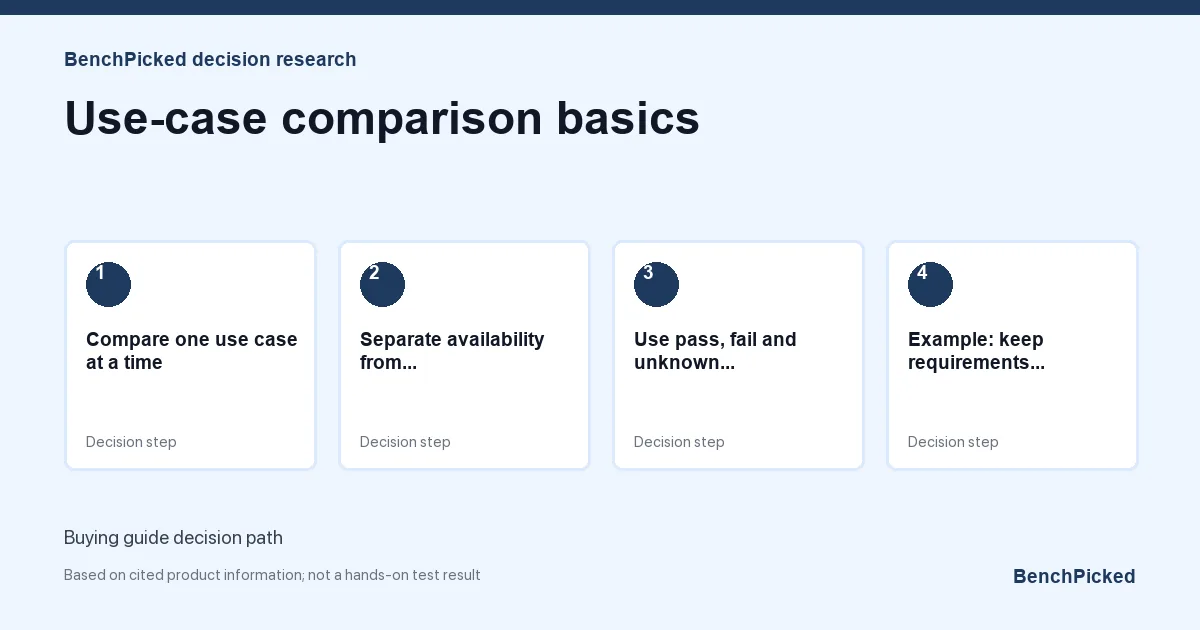
Compare one use case at a time. Separate availability from effectiveness. Use pass, fail and unknown instead of a single score. Example: keep requirements separate from preferences.
Written by BenchPicked Editorial Team · Sources checked Sep 15, 2026
Decision answer
Bottom line
Create separate comparisons for different tasks instead of combining unrelated features into one score. The FTC recommends checking model details and the total purchase cost. For our decision worksheet, document the task, constraints and evidence for each candidate side by side.
- For
- people evaluating a single-purpose household gadget before accepting its promotional claim
- Decision
- use use-case comparison basics to make a product decision without overreading promotional claims
- Context
- checking mechanism, coverage, compatibility, power, warranty and return conditions
Decision matrix
Read each published value in the context of the decision it can actually support.
| Factor | Published information | How to use it |
|---|---|---|
| Compare one use case at a time | Create separate comparisons for different tasks instead of combining unrelated features into one score. The FTC recommends checking model details and the total purchase cost. For our decision worksheet, document the task, constraints and evidence for each candidate side by side. | Apply this step to the exact product, room, device or purchase terms being compared. |
| Separate availability from effectiveness | A working checkout link establishes a purchase path, not that the device solves the problem. For a claimed effect, ask what supports it and whether the evidence applies to this model and use case. If those answers are missing, compare better-documented alternatives before committing. | Apply this step to the exact product, room, device or purchase terms being compared. |
| Use pass, fail and unknown instead of a single score | Start with requirements that can change the answer: physical fit, supported environment, power, maintenance, recurring purchases and return conditions. Mark a candidate pass only when a cited source supports the requirement, fail only when the documentation clearly conflicts, and unknown when the evidence is absent. Keep convenience preferences in a separate weighted section so they cannot compensate for a failed requirement. This prevents a large advertised feature list from overpowering one essential incompatibility. The final recommendation should explain the decisive requirement and the remaining uncertainty, not merely report which product accumulated the most points. | Apply this step to the exact product, room, device or purchase terms being compared. |
| Example: keep requirements separate from preferences | For a device intended for a small cabinet, dimensions and permitted operating location may be pass-or-fail requirements. Color, display style and a minor convenience feature are preferences. Build the comparison in that order. A candidate with attractive preferences does not move forward while cabinet fit is unknown. Once both products pass the required fields, apply disclosed preference weights and show how changing a weight changes the result. If an effectiveness claim lacks model-specific support, keep that field outside the score and explain what evidence would resolve it. This prevents mathematical precision from disguising incomplete inputs and gives readers a decision they can adapt. | Apply this step to the exact product, room, device or purchase terms being compared. |
Claim and evidence record
contextual guidance
Create separate comparisons for different tasks instead of combining unrelated features into one score. The FTC recommends checking model details and the total purchase cost. For our decision worksheet, document the task, constraints and evidence for each candidate side by side.
Apply the cited guidance to the exact product documentation; it is not a product-performance finding.
FTC online shopping guidanceWhen another option is the better fit
A conventional tool for the same job
Choose this when reliability matters more than convenience claims.
A documented competing product
Choose this when the seller cannot provide operating specifications.
No purchase
Choose this when the underlying problem has not been identified or measured.
Product example
Apply these criteria to Vermix Pulse Pro Pest Repeller
Use this approved product option as a concrete example while applying the criteria on this page. Confirm its published specifications and current seller terms before ordering.
Read the product researchSource notes
- FTC Online Shopping Guidance · Government · Checked Sep 15, 2026
- FTC Warranty Guidance · Government · Checked Sep 15, 2026
Questions
Should missing information receive a zero score?
No. Record it as unknown and state what would resolve it. Zero can be mistaken for a measured result or a confirmed absence.
Can an unknown requirement be treated as a pass?
No. Resolve it with model-specific documentation or keep the candidate conditional. An unanswered compatibility question can reverse the purchase decision.
When is a numerical score useful?
After essential requirements pass and comparable evidence exists. Publish the weights and inputs so a reader can reproduce or change the result.
Before you buy
Recheck fit and current terms
Compare Vermix Pulse Pro Pest Repeller with the criteria on this page, then confirm the current seller terms.
How BenchPicked separates published facts, analysis, and evidence limits