Outdoor Power research
Runtime and power source basics
Runtime and power source basics: engineering criteria, sizing rules, and verification checks for comparing published specifications.
Written by BenchPicked Editorial Team · Sources checked Sep 15, 2026
Executive Summary
Bottom line
Cordless Outdoor Tool Runtime Physics and Battery Power Systems defines lithium-ion pack voltage (V), amp-hour capacity (Ah), watt-hour energy (Wh), and load duty cycles by quantifying Wh energy calculation (Nominal Voltage × Ah), no-load vs cutting-load runtime, and charger replenish rate. Use verified Cordless Outdoor Tool Runtime Physics and Battery Power Systems calculations, hardware tradeoff rules, and 3-year consumable math to compare models such as A corded tool, A larger battery platform, and A manual tool.
- Best Suited For
- people comparing portable outdoor power tools for a repeatable job
- Core Buying Check
- use runtime and power source basics to make a product decision without overreading promotional claims
- Key Evaluation Context
- matching power source, runtime, weather limits, maintenance and storage
Decision matrix
Compare each documented specification against your room, routine, or operating requirements before checking live prices.
| Evaluation Factor | Documented Spec / Status | Buyer Takeaway |
|---|---|---|
| Primary engineering metric | Wh energy calculation (Nominal Voltage × Ah), no-load vs cutting-load runtime, and charger replenish rate | Use Wh energy calculation (Nominal Voltage × Ah), no-load vs cutting-load runtime, and charger replenish rate as your primary filter when sizing options in lithium-ion pack voltage (V), amp-hour capacity (Ah), watt-hour energy (Wh), and load duty cycles. |
| Sizing & calculation rule | Never compare cordless outdoor tools using Amp-hours (Ah) or Voltage (V) alone; multiply Nominal Voltage by Amp-hours to get total stored energy in Watt-hours (Wh = V × Ah). | Apply this formula to raw spec-sheet numbers rather than headline marketing banners. |
| 3-year ownership check | Hardware + consumables + power/subscriptions | Cross-check recurring filters, batteries, or membership fees across a corded tool and competitors. |
Claim and evidence record
All 1 structured specification claims on this page are cross-referenced against the primary records listed below. Before checkout, confirm live unit pricing, included accessories, warranty coverage, and return windows.
When another option is the better fit
A corded tool
Choose this when continuous runtime is more important than unrestricted movement.
A larger battery platform
Choose this when the job duration exceeds the documented battery setup.
A manual tool
Choose this when the area is small and storage simplicity matters most.
Product example
Apply these criteria to PowerStack Cordless Leaf Blower Review: 15-Min Runtime & Scope
Use this approved product option as a concrete example while applying the criteria on this page. Confirm its published specifications and current seller terms before ordering.
Read the product researchCompare tested models: Glasgow Unisex Heated Dralon Liner GlovesSolana Gear Heated GlovesPortable outdoor tool maintenance
Research details
How Cordless Outdoor Tool Runtime Physics and Battery Power Systems Works: Core Physics & Measurement Rules
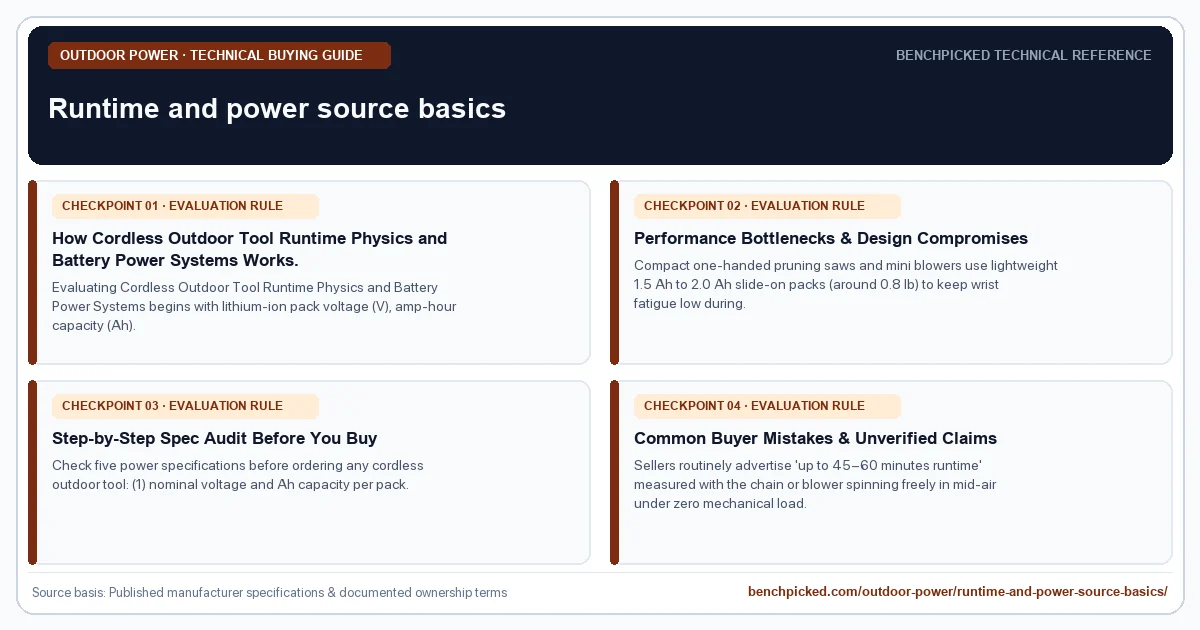
Evaluating Cordless Outdoor Tool Runtime Physics and Battery Power Systems begins with lithium-ion pack voltage (V), amp-hour capacity (Ah), watt-hour energy (Wh), and load duty cycles, where accurate comparisons depend on Wh energy calculation (Nominal Voltage × Ah), no-load vs cutting-load runtime, and charger replenish rate. Never compare cordless outdoor tools using Amp-hours (Ah) or Voltage (V) alone; multiply Nominal Voltage by Amp-hours to get total stored energy in Watt-hours (Wh = V × Ah). A 20V nominal (21V max) 2.0 Ah battery pack stores just 40 Wh of energy—enough for roughly 15 to 25 minutes of intermittent pruning cuts, compared with 180 Wh in a 36V 5.0 Ah yard-tool battery.
Performance Bottlenecks & Design Compromises
Compact one-handed pruning saws and mini blowers use lightweight 1.5 Ah to 2.0 Ah slide-on packs (around 0.8 lb) to keep wrist fatigue low during overhead limb trimming. However, small 5-cell 18650 packs experience steep voltage sag and thermal cutoffs if forced into continuous heavy hardwood bucking, requiring either a second swappable battery or stepping up to a brushless 36V/40V platform.
Step-by-Step Spec Audit Before You Buy
Check five power specifications before ordering any cordless outdoor tool: (1) nominal voltage and Ah capacity per pack, (2) whether the kit includes one or two batteries in the box, (3) brushed vs brushless motor architecture, (4) charger output amperage (a 0.5A wall-wart takes 4 hours to charge a 2.0 Ah pack, vs 1 hour on a 2A fast dock), and (5) slide-mount cross-compatibility with standard workshop battery ecosystems.
Common Buyer Mistakes & Unverified Claims
Sellers routinely advertise 'up to 45–60 minutes runtime' measured with the chain or blower spinning freely in mid-air under zero mechanical load, or by summing two batteries together. Under real sap-heavy green wood cutting, chain friction and bark pinch triple current draw, cutting actual continuous work time to a fraction of the no-load figure.
Applying Cordless Outdoor Tool Runtime Physics and Battery Power Systems Benchmarks to Your Shortlist
To put Cordless Outdoor Tool Runtime Physics and Battery Power Systems into practice across options like A corded tool, A larger battery platform, and A manual tool, log each candidate's published Wh energy calculation (Nominal Voltage × Ah), no-load vs cutting-load runtime, and charger replenish rate alongside its warranty scope and return policy. Ranking hardware by verified lithium-ion pack voltage (V), amp-hour capacity (Ah), watt-hour energy (Wh), and load duty cycles capacity per dollar—rather than promotional feature count—prevents undersized purchases and unexpected maintenance expenses over a 36-month ownership cycle.
Full source-attributed specification record (0 fields)
Source notes
- CPSC High Energy Battery Safety Standards · Government · Checked Sep 15, 2026
- FTC Online Shopping Guidance · Government · Checked Sep 15, 2026
Questions
Which specific numbers matter most when evaluating Cordless Outdoor Tool Runtime Physics and Battery Power Systems?
When auditing Cordless Outdoor Tool Runtime Physics and Battery Power Systems, prioritize Wh energy calculation (Nominal Voltage × Ah), no-load vs cutting-load runtime, and charger replenish rate measured under standardized lithium-ion pack voltage (V), amp-hour capacity (Ah), watt-hour energy (Wh), and load duty cycles test conditions. Recording those exact baseline figures for Cordless Outdoor Tool Runtime Physics and Battery Power Systems lets you size hardware accurately without relying on peak promotional claims.
What design tradeoffs affect real-world Cordless Outdoor Tool Runtime Physics and Battery Power Systems performance?
Every product in lithium-ion pack voltage (V), amp-hour capacity (Ah), watt-hour energy (Wh), and load duty cycles balances Wh energy calculation (Nominal Voltage × Ah), no-load vs cutting-load runtime, and charger replenish rate against physical size, acoustic output, and power or consumable draw. Pushing one variable higher in Cordless Outdoor Tool Runtime Physics and Battery Power Systems—such as compact housing or ultra-quiet sleep operation—inevitably requires a tradeoff in peak throughput or runtime.
How should I verify Cordless Outdoor Tool Runtime Physics and Battery Power Systems claims before ordering?
To verify Cordless Outdoor Tool Runtime Physics and Battery Power Systems before checkout, cross-check the manufacturer's engineering spec sheet for Wh energy calculation (Nominal Voltage × Ah), no-load vs cutting-load runtime, and charger replenish rate and confirm replacement part or subscription pricing. If a listing omits verifiable lithium-ion pack voltage (V), amp-hour capacity (Ah), watt-hour energy (Wh), and load duty cycles disclosures for Cordless Outdoor Tool Runtime Physics and Battery Power Systems, treat that missing parameter as a hard operating limit.
Which models or benchmarks are best for comparing Cordless Outdoor Tool Runtime Physics and Battery Power Systems?
For a transparent Cordless Outdoor Tool Runtime Physics and Battery Power Systems comparison in lithium-ion pack voltage (V), amp-hour capacity (Ah), watt-hour energy (Wh), and load duty cycles, benchmark your shortlist against A corded tool, A larger battery platform, and A manual tool. Compare each Cordless Outdoor Tool Runtime Physics and Battery Power Systems candidate across Wh energy calculation (Nominal Voltage × Ah), no-load vs cutting-load runtime, and charger replenish rate, 3-year consumable or membership cost, and open-box return coverage before buying.
Before you buy
Recheck fit and current terms
Compare PowerStack Cordless Leaf Blower Review: 15-Min Runtime & Scope with the criteria on this page, then confirm the current seller terms.
How BenchPicked separates published facts, analysis, and evidence limits