Air Quality research
Air purifier noise levels
Air purifier noise levels explained with source boundaries, specification context, and BenchPicked methodology notes.
Written by BenchPicked Editorial Team · Sources checked May 16, 2026
Decision answer
Bottom line
Air purifier noise levels are usually reported in decibels across fan speeds, so the useful comparison is the published dB range rather than one quiet-mode number.
- For
- people choosing a room air cleaner for a defined room and operating routine
- Decision
- use air purifier noise levels to make a product decision without overreading promotional claims
- Context
- matching cleaned-air delivery, noise, filter upkeep and room conditions
Decision matrix
Read each published value in the context of the decision it can actually support.
| Factor | Published information | How to use it |
|---|---|---|
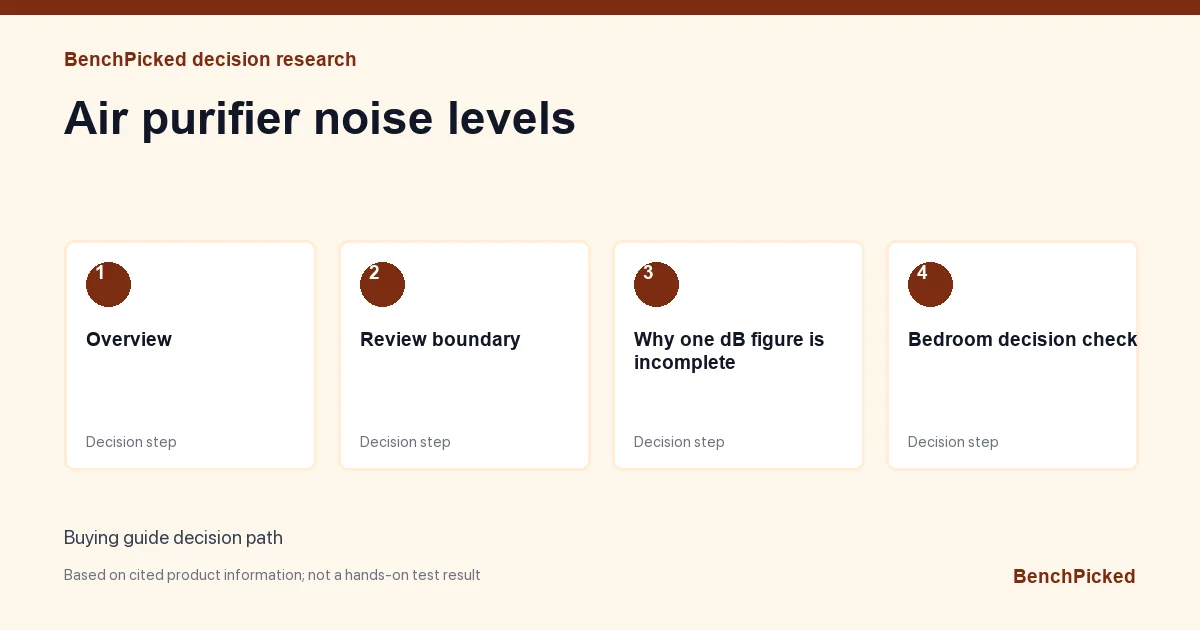
| Overview | Air purifier noise levels are usually reported in decibels across fan speeds, so the useful comparison is the published dB range rather than one quiet-mode number. | Apply this step to the exact product, room, device or purchase terms being compared. |
| Review boundary | BenchPicked separates general background information from product performance claims. | Apply this step to the exact product, room, device or purchase terms being compared. |
Claim and evidence record
contextual guidance
Air purifier noise levels are usually reported in decibels across fan speeds, so the useful comparison is the published dB range rather than one quiet-mode number.
Apply the cited guidance to the exact product documentation; it is not a product-performance finding.
EPA guide to air cleaners in the homeWhen another option is the better fit
A higher-CADR purifier
Choose this when the room is larger or faster air cleaning matters more than size.
A quieter compact purifier
Choose this when night use and close placement matter more than peak airflow.
Source control or ventilation
Choose this when the pollutant source can be removed instead of filtered.
Decision support
Fit and ownership checks
Fits when
- Readers matching this audience: people choosing a room air cleaner for a defined room and operating routine
- Decisions that require this task: use air purifier noise levels to make a product decision without overreading promotional claims
- Use in this stated context: matching cleaned-air delivery, noise, filter upkeep and room conditions
Complete before comparing total cost
- Current device price, shipping region, and availability
- Required accessories, consumables, or paid services
- Warranty, return window, and seller-specific exclusions
- Any unpublished recurring cost needed for a like-for-like ownership comparison
Sources used for this decision
- EPA guide to air cleaners in the home: Government record used for the published facts on this page.
- AHAM Verifide room air cleaner directory: Industry Standard record used for the published facts on this page.
Evidence boundary: this module compares cited published information. It does not add first-hand measurements or infer results outside the stated source conditions.
Product example
Apply these criteria to Levoit Core 300S: CADR, Room Fit, Noise, and Filter Costs
Use this approved product option as a concrete example while applying the criteria on this page. Confirm its published specifications and current seller terms before ordering.
Read the product researchResearch details
Overview
Air purifier noise levels are usually reported in decibels across fan speeds, so the useful comparison is the published dB range rather than one quiet-mode number.
Review boundary
BenchPicked separates general background information from product performance claims.
Why one dB figure is incomplete
Noise changes with fan speed and test setup. A minimum figure may describe sleep mode while the CADR or coverage claim may rely on a higher setting.
Bedroom decision check
Compare the published range, controls, display-light behavior, and the speed you can tolerate overnight. Missing speed-specific noise remains unknown.
Airflow tradeoff
Lower fan speed usually changes cleaning rate. Evaluate noise and air-cleaning performance together rather than ranking products by the quietest published number alone.
Source notes
- EPA Guide To Air Cleaners In The Home · Government · Checked May 16, 2026
- AHAM Verifide Room Air Cleaner Directory · Industry Standard · Checked May 16, 2026
Questions
How should air purifier noise be compared?
Compare the published decibel range across fan speeds, not only the lowest sleep-mode number.
Why do quiet-mode numbers look much lower?
Quiet or sleep mode usually runs at a lower fan speed, which may also reduce airflow compared with higher settings.
Is a lower dB rating always better?
Not by itself. Noise should be read together with CADR, coverage, and the fan speed used for the rating.
Before you buy
Recheck fit and current terms
Compare Levoit Core 300S: CADR, Room Fit, Noise, and Filter Costs with the criteria on this page, then confirm the current seller terms.
How BenchPicked separates published facts, analysis, and evidence limits