EMF research
Best EMF Meters for Home Use: Specs, Field Types, and Testing Criteria
A practical EMF meter buying guide built around field type coverage, published specs, measurement limits, and repeatable home testing.
Short answer
How to choose an EMF meter for home screening
Choose a meter by field type first: RF for wireless sources, AC magnetic for current flow, and AC electric for voltage-related fields. Broad home screening usually needs all three modes, while final product rankings need repeatable side-by-side readings.
- Trifield TF2 and Cornet ED88T Plus are common consumer options to compare.
- A consumer meter can help find sources and compare conditions, but it does not replace a professional survey.
- BenchPicked does not turn meter readings into health-effect claims.
Source check
What the shortlist can decide before hands-on readings
The shortlist can separate meters that cover the needed field types from meters that do not. It can also show whether published specs are clear enough for source-finding, shielding comparisons, and repeatable home notes.
- RF, AC magnetic, and AC electric coverage are evaluated separately.
- Specification tables are source-attributed and do not imply lab-grade accuracy.
- Final ranking language waits for repeated readings under controlled conditions.
What this guide covers
Choose meters by field type coverage, published specs, reading conditions, and source quality before trusting a product claim.
What makes this page useful
A meter selection framework that separates RF, AC magnetic, and AC electric field coverage from health claims and unverified product rankings.
Source and specification basis
This page uses source-attributed product specifications and physical claim boundaries. Hands-on conclusions appear only on pages labeled as tested by BenchPicked.
- Manufacturer or manual specification source
- Field type and frequency range details
- Seller or affiliate source checked near publication
- Source boundary statement
Specification profile
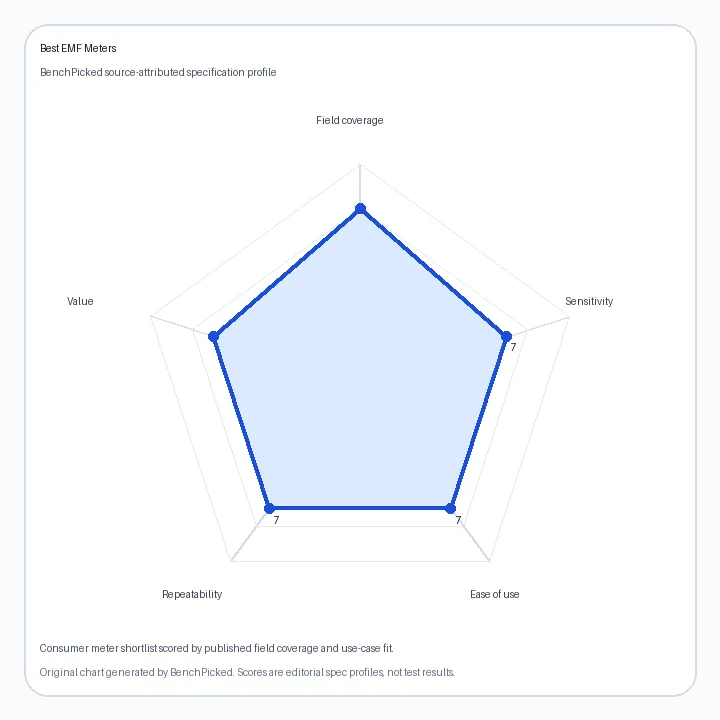
Visual guide
Published specs and sources
| Meter | Field coverage | Published range or limit | Source basis |
|---|---|---|---|
| Trifield TF2 | AC magnetic, AC electric, and RF fields | AC modes: 40 Hz to 100 kHz; RF mode: 20 MHz to 6 GHz | Manufacturer specification sheet |
| Trifield TF2 | Display and power context | Digital LCD display with 9V alkaline battery power | Manufacturer specification sheet |
| Cornet ED88T Plus | RF, low-frequency electric, and low-frequency magnetic screening modes | RF: 100 MHz to 8 GHz; LF magnetic: 50 Hz to 10 kHz or 50 Hz to 1 kHz mode; E-field: 50 Hz to 50 kHz | Cornet user manual and specification page |
| Cornet ED88T Plus | Consumer screening context | Broadband screening device for source-finding and relative comparison, not compliance-grade survey work | Manufacturer manual and BenchPicked boundary |
| Professional survey instruments | Application-specific calibrated probes and meters | Range depends on probe and calibration package | Professional survey boundary |
BenchPicked uses published meter specifications to shortlist devices. Final product rankings require repeatable readings under the same source, distance, orientation, and mode.
Comparison set
- Trifield TF2 - A consumer meter designed to measure AC magnetic, AC electric, and RF fields in one device.
- Cornet ED88T Plus - A broadband consumer meter positioned for RF plus low-frequency electric and magnetic field screening.
- Professional survey instruments - Higher-cost calibrated instruments for formal surveys rather than basic home screening.
Decision Guide
A useful home EMF meter comparison starts with field coverage, not brand ranking. RF, AC magnetic, and AC electric fields require different sensors, units, and reading habits.
The consumer EMF meter selection set below separates general home screening from product shielding verification so readers know what a meter can and cannot prove.
| Meter type | Best fit | Measurement limits | What BenchPicked checks |
|---|---|---|---|
| Tri-mode consumer meter | General home screening across RF, AC magnetic, and AC electric fields. | Not lab-calibrated for regulatory compliance. | Field type coverage, axis behavior, display units, repeatability, and setup clarity. |
| RF-focused meter | Comparing wireless sources, shielding fabric, phone cases, and router placement. | Does not cover powerline magnetic or electric fields unless the model includes LF modes. | RF range, display resolution, hold behavior, and fixed-distance readings. |
| Professional survey instrument | Compliance-grade surveys, legal disputes, and calibrated reporting. | Higher cost and more setup knowledge required. | Outside BenchPicked consumer product scoring until a professional source is used. |
How to shortlist a meter
- Decide whether the main use case is home source-finding, shielding comparison, or product review work.
- Confirm which field types the meter measures before comparing prices.
- Check units, axis count, frequency range, and whether the manual explains distance and orientation.
- Treat final buying advice as separate from health-risk claims.
Why field coverage comes before brand preference
A meter that cannot detect the field type in question will create false confidence no matter how popular the brand is. RF sources, AC magnetic sources, and AC electric sources need different modes and different reading habits.
BenchPicked uses published specs to build the shortlist, then uses repeatable reading conditions before making stronger product conclusions.
What a published spec can and cannot do
- A published spec can show whether the meter claims RF, AC magnetic, and AC electric coverage.
- A published spec can show frequency boundaries, units, battery type, and basic operating limits.
- A published spec cannot prove that one meter is more useful in a specific room without side-by-side readings.
- A published spec cannot turn an EMF reading into a health-effect conclusion.
Common questions
What types of EMF can a consumer meter detect?
Many consumer meters detect RF fields, AC magnetic fields, and AC electric fields. Some are RF-only or LF-only, so the first filter is field type coverage.
How accurate are consumer EMF meters?
Consumer EMF meters are useful for relative comparisons and source-finding, not lab-grade compliance work. BenchPicked separates meter mode, units, distance, orientation, and repeatability from any final product conclusion.
Do I need an EMF meter before buying a shielding product?
A meter helps verify whether a physical shielding product changes readings under the same conditions. Without measurements, the claim is harder to separate from marketing copy.
Does BenchPicked decide whether EMF exposure is safe?
No. BenchPicked explains physical field concepts and product claims separately from health risk. We do not diagnose, evaluate personal risk, or make health-effect claims.