EMF research
Do EMF Shields Work? What Can Be Measured and What Cannot
A source-attributed guide to EMF shielding products, conductive materials, harmonizer claims, orientation, and measurable field-change concepts.
Short answer
When EMF shields can be measured
EMF shields can be measured when they use physical conductive material or enclosure geometry that changes field readings under controlled conditions. BenchPicked reports the field change, not a health-effect conclusion.
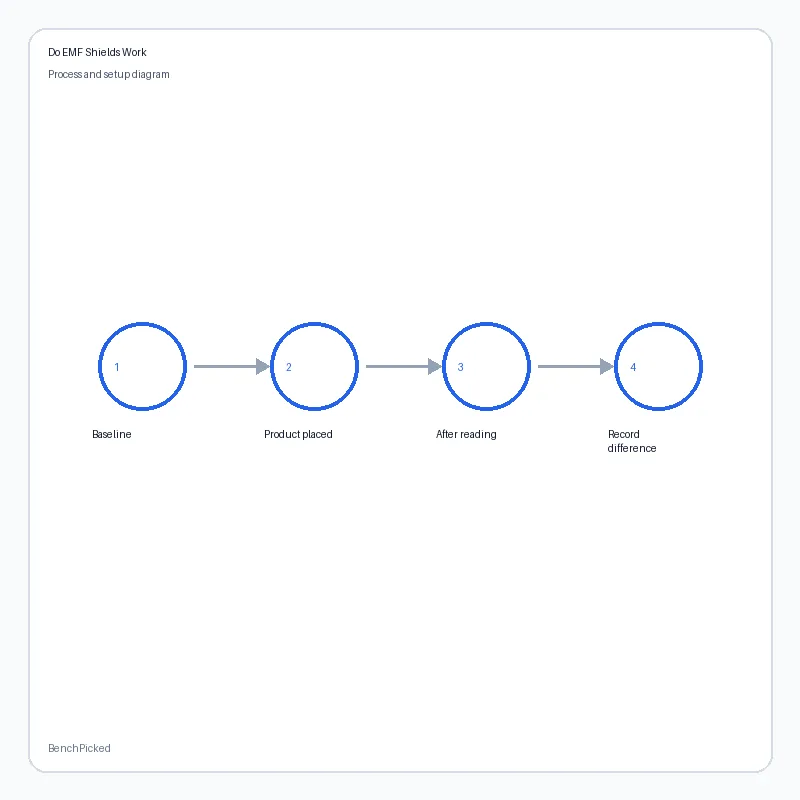
- Shielding tests need baseline and shielded readings.
- Orientation and source behavior can change the result.
- Unmeasurable harmonizer claims are not scored as physical shielding evidence.
What this guide covers
Explain shielding mechanics in plain language without turning field concepts into medical or health-risk conclusions.
What makes this page useful
A practical claim framework separating physically measurable shielding from mechanisms that standard EMF meters cannot verify.
Information basis
This page is informational and separates field physics, product categories, and health-claim boundaries.
- Public source review
- Health-claim boundary check
- Related methodology or disclosure link
Visual guide
Decision Guide
Physical shielding products that use conductive materials can reduce EMF readings by a measurable amount when the material, geometry, and orientation match the field being tested.
BenchPicked separates product specifications, physical mechanisms, and health-effect claims. Hands-on conclusions appear only when a page is labeled as tested by BenchPicked.
| Claim type | Measurement fit | BenchPicked treatment |
|---|---|---|
| Conductive fabric or mesh | Can be tested by comparing readings with and without the material in the same setup. | Measure field change and report conditions. |
| Faraday pouch or enclosure | Can be tested by checking inside and outside readings under repeatable source conditions. | Measure attenuation while noting signal loss and orientation. |
| Phone case with one shielded side | Can be tested only when orientation and distance are fixed. | Compare shielded side, unshielded side, and no-case readings. |
| Sticker, pendant, or harmonizer | Standard EMF meters may show no field-strength change. | Classify as not verifiable with BenchPicked physical measurement methods unless a measurable mechanism is supplied. |
What a shielding test should control
- Name the field type before choosing a meter mode.
- Record distance, orientation, baseline reading, and source behavior.
- Repeat the reading enough times to separate a real change from noise.
- Report the result as a physical field measurement, not a health claim.
Common questions
What is the difference between shielding and harmonizing?
Shielding uses conductive material or geometry to block, redirect, or attenuate fields in a measurable way. Harmonizing or neutralizing claims need a measurable mechanism before BenchPicked can test them with standard EMF instruments.
Can I test a shielding product at home?
Yes, for simple physical shielding claims. Use the same source, distance, orientation, meter mode, and repeat count with and without the product.
Why can some shields change device behavior?
If shielding blocks a device signal path, the device may adjust transmit power or connection behavior. Orientation and signal condition therefore belong in the test notes.
Are EMF protection stickers and pendants measurable?
BenchPicked can only verify claims that create a measurable field change with a defined method. Claims without a measurable mechanism fall outside our physical product test method.
What is the simplest way to reduce a reading?
Distance is often the simplest variable. Moving farther from a source can reduce readings without adding a shielding product.
Does BenchPicked decide whether EMF exposure is safe?
No. BenchPicked explains physical field concepts and product claims separately from health risk. We do not diagnose, evaluate personal risk, or make health-effect claims.