EMF research
EMF Meter Specs: Frequency Range, Units, Axis Count, and Test Conditions
A technical guide to the EMF meter specs that matter for home screening, shielding comparisons, and source-attributed product research.
Specs guide
Which EMF meter specs matter most
The most important EMF meter specs are field type coverage, frequency range, axis behavior, units, display behavior, and setup instructions. Specs define what the meter can detect before any hands-on comparison is meaningful.
Decision support
How to use the published evidence for EMF Meter Specs: Frequency Range, Units, Axis Count, and Test Conditions
Evidence boundary: this page currently relies on one cited source record. Treat the decision as source-limited until another applicable source is added.
Fits when
- Readers matching this audience: Readers comparing published product information and decision limits
- Decisions that require this task: Informational
- Use in this stated context: This page uses source-attributed product specifications and physical claim boundaries. Hands-on conclusions appear only on pages labeled as tested by BenchPicked.
Compare another option when
- Unpublished conditions is required but remains not established by the cited records
- A required specification is absent from the cited records
- The exact model, market, or seller terms differ from the source context shown here
| Factor | Published context | Decision use |
|---|---|---|
| Evidence coverage | 0 cited sources | Treat a single-source field as provisional until a second applicable source is available. |
| Unpublished conditions | Not established by the cited records | Do not convert an omitted condition into a zero value or a positive product claim. |
Complete before comparing total cost
- Current device price, shipping region, and availability
- Required accessories, consumables, or paid services
- Warranty, return window, and seller-specific exclusions
- Any unpublished recurring cost needed for a like-for-like ownership comparison
What this guide covers
Understand the technical limits that decide what a consumer EMF meter can and cannot detect.
What makes this page useful
Spec interpretation that helps readers connect meter limits to source quality and claim boundaries before trusting a product claim.
Source and specification basis
This page uses source-attributed product specifications and physical claim boundaries. Hands-on conclusions appear only on pages labeled as tested by BenchPicked.
- Manufacturer or manual specification source
- Field type and frequency range details
- Seller or affiliate source checked near publication
- Source boundary statement
Visual guide
Decision Guide
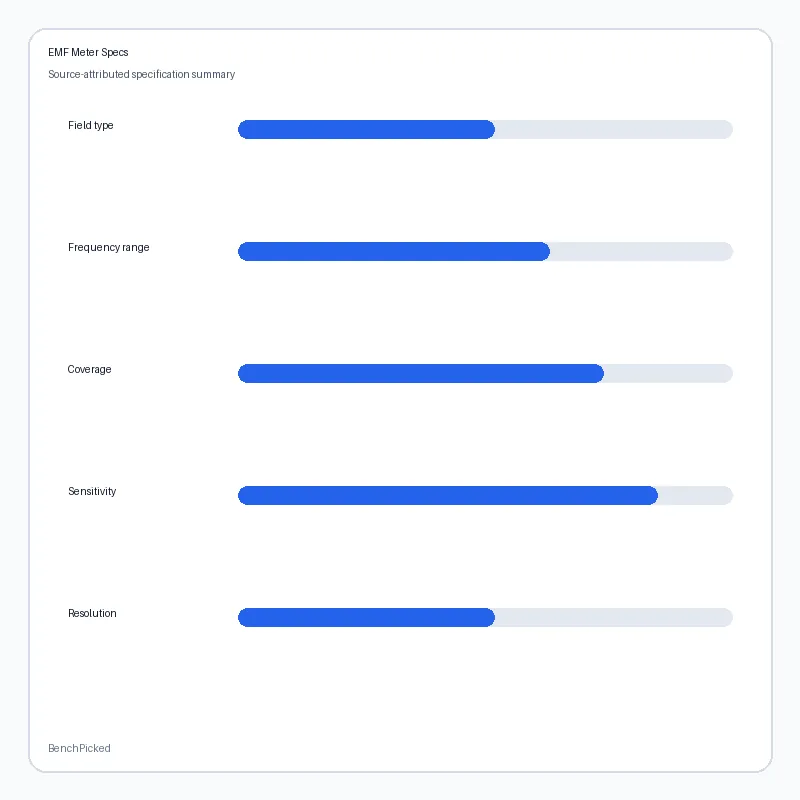
Consumer EMF meters differ in frequency range, sensor type, axis count, and display resolution. Specs help set expectations before a reader buys a meter or trusts a shielding claim.
Published specs are useful for screening, but BenchPicked separates spec comparison from real side-by-side measurement evidence.
| Spec | Why it matters | What to check |
|---|---|---|
| Field type coverage | A meter may measure RF only, low-frequency magnetic fields only, or multiple field types. | Confirm RF, AC magnetic, and AC electric modes if the use case needs all three. |
| Frequency range | A meter cannot detect signals outside its published RF or LF range. | Compare the meter range against the device sources you want to evaluate. |
| Axis behavior | Tri-axis sensors reduce the need to rotate the meter for magnetic or electric readings. | Check whether the meter is tri-axis, single-axis, or mode-dependent. |
| Units and hold modes | A readable display makes repeated product comparisons easier. | Look for clear units, peak hold or max hold, and manual instructions for distance. |
When consumer specs are not enough
Consumer meters are useful for relative comparisons and source-finding. Professional surveys require calibrated instruments, defined procedures, and traceable standards.
Common questions
What frequency range do I need for general home use?
General screening needs coverage for powerline-frequency fields and the RF sources the reader wants to investigate. A meter cannot detect signals outside its published range.
What is tri-axis vs single-axis?
A single-axis sensor measures one direction at a time. A tri-axis sensor can combine readings across three directions, which can make repeatable home screening easier.
Can consumer meters replace professional EMF surveys?
No. Professional surveys use calibrated instruments, defined procedures, and traceable standards. Consumer meters are best for source-finding and relative comparisons.
How accurate are consumer EMF meters?
Consumer EMF meters are useful for relative comparisons and source-finding, not lab-grade compliance work. BenchPicked separates meter mode, units, distance, orientation, and repeatability from any final product conclusion.