EMF research
Trifield TF2 Review: Specs, Measurement Modes, and Limits
The Trifield TF2 combines RF, AC magnetic, and AC electric screening. Compare its published ranges, practical buying fit, and important measurement limits.
Review focus
Review verdict: useful three-mode screening with clear limits
The TF2 is worth considering when one handheld meter must screen RF, AC magnetic, and AC electric fields. Its published 20 MHz to 6 GHz RF range and 40 Hz to 100 kHz AC ranges define the buying fit; they do not prove comparative accuracy or replace a professional survey.
- RF, magnetic, and electric readings are reported separately.
- Any cited measurement should identify its source, distance, orientation, meter mode, and repeat count.
- Product ratings stay out until source support and scoring exist.
Source check
What the published TF2 specs already tell readers
The published TF2 specs show that the meter is positioned for tri-mode home screening, with separate RF, AC magnetic, and AC electric ranges. Use that coverage to judge suitability, while keeping unmeasured accuracy and repeatability separate.
- The page names the field modes and frequency ranges used in the spec table.
- The review boundary keeps consumer screening separate from professional surveys.
- The page does not publish product-rating data before the verdict is supported.
Decision support
TF2 buying fit by measurement task
| Factor | Published context | Decision use |
|---|---|---|
| Modes | RF, AC magnetic, AC electric | Select the correct mode and unit before comparing readings. |
| RF range | 20 MHz to 6 GHz (manufacturer-published) | Do not infer mmWave coverage. |
| AC ranges | 40 Hz to 100 kHz (manufacturer-published) | Keep magnetic and electric readings separate. |
Fits when
- Separating three field types in home screening
- Checking sources under repeatable distance and orientation notes
- Buyers who need one meter rather than separate single-mode tools
Compare another option when
- The required frequency falls outside a published range
- The job requires calibrated compliance measurements
- Data logging, probes, or documented uncertainty are mandatory
Complete before comparing total cost
- Exact model and included accessories
- Manual and published range
- Seller warranty and return terms
- Whether the task requires calibration records
Sources used for this decision
- TriField TF2 official product page: Manufacturer-published modes, ranges, and product documentation.
BenchPicked reviewed the published specification boundary. This module does not add measured accuracy, repeatability, or health claims.
What this guide covers
Evaluate one EMF product with source notes, orientation requirements, physical mechanism, and health-claim boundaries.
What makes this page useful
Source-attributed TF2 capabilities, use-case fit, and limitations, separated from unmeasured performance claims.
Source and specification basis
This page uses source-attributed product specifications and physical claim boundaries. Hands-on conclusions appear only on pages labeled as tested by BenchPicked.
- Manufacturer or manual specification source
- Field type and frequency range details
- Seller or affiliate source checked near publication
- Source boundary statement
Specification profile
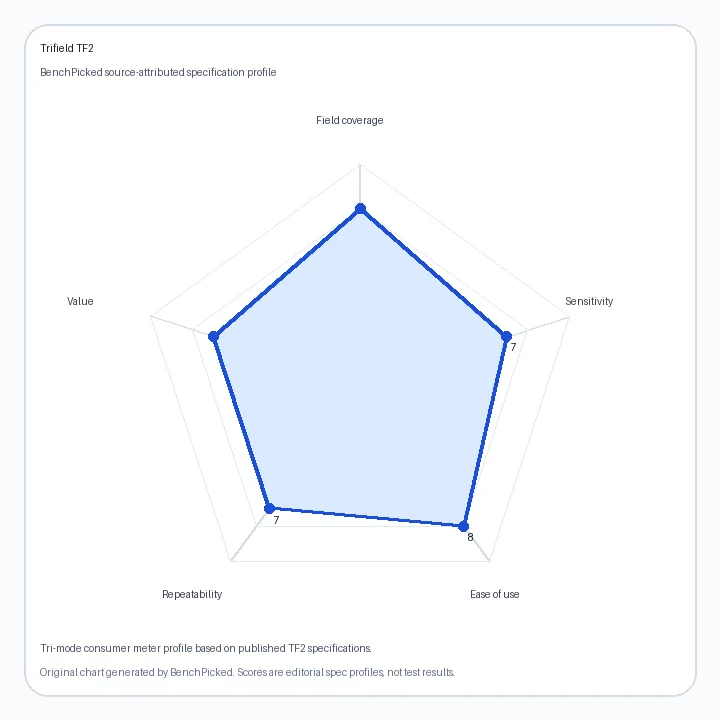
Visual guide
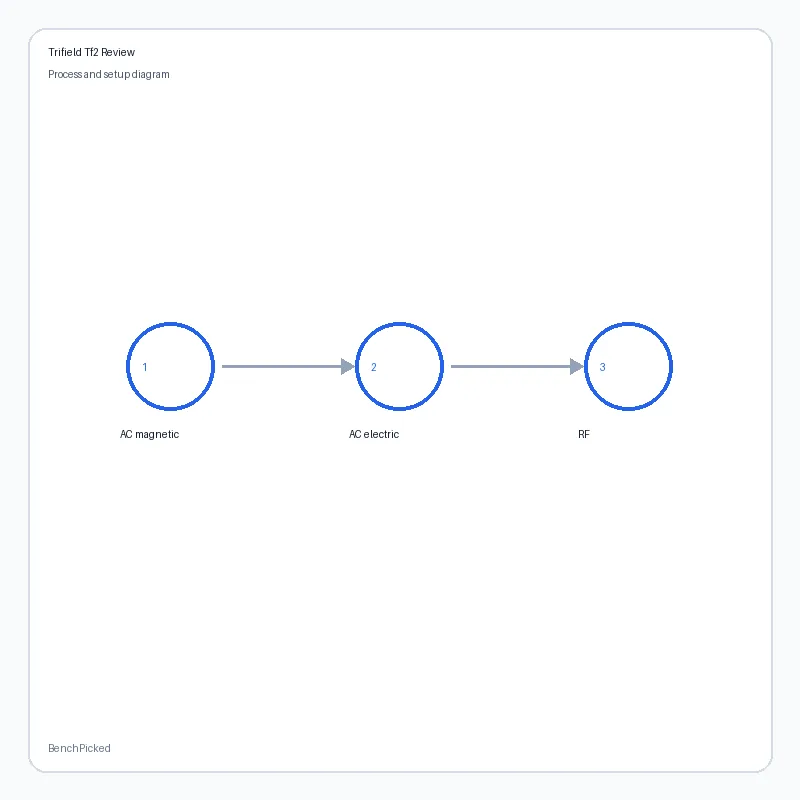
Published specs and sources
| Spec field | Source-attributed TF2 value | Source basis |
|---|---|---|
| Field modes | AC magnetic, AC electric, and RF fields in one handheld consumer meter | Manufacturer product page |
| AC magnetic range | 40 Hz to 100 kHz | Manufacturer specification sheet |
| AC electric range | 40 Hz to 100 kHz | Manufacturer specification sheet |
| RF range | 20 MHz to 6 GHz | Manufacturer specification sheet |
| Published magnetic accuracy | ±4% at 50/60 Hz | Manufacturer specification sheet |
| Published electric accuracy | ±5% | Manufacturer specification sheet |
| Published RF accuracy | ±20% at 1 GHz | Manufacturer specification sheet |
| RF power-density range | 0.001 to 19.999 mW/m² | Manufacturer specification sheet |
| Magnetic axis context | 3-axis magnetic measurement | Manufacturer specification sheet |
| Power | 9V alkaline battery | Manufacturer specification sheet |
| Use case | Home screening and relative comparisons rather than professional compliance surveys | BenchPicked measurement boundary |
| Review boundary | Buying fit uses documented modes, frequency ranges, compatibility, and price; measured accuracy needs separate evidence | BenchPicked editorial criteria |
This table is a source-attributed spec record, not a BenchPicked reading log.
Common questions
What does the Trifield TF2 measure?
The Trifield TF2 is sold as a consumer meter for AC magnetic, AC electric, and RF fields. BenchPicked evaluates those modes separately because each field type uses different units and reading behavior.
Can the Trifield TF2 measure 5G signals?
The TF2 can detect RF signals inside its published RF range, including many sub-6 GHz wireless sources. It should not be treated as a mmWave 5G survey instrument.
When is the TF2 worth considering?
Consider it when its documented RF, magnetic, and electric modes cover your home-screening needs. Compare the manual, frequency ranges, display functions, and current price; do not choose it for measurements outside those ranges.
Is the Trifield TF2 a good all-in-one EMF meter?
It is a practical shortlist candidate when you need RF, AC magnetic, and AC electric screening in one handheld meter. That convenience does not establish lab-grade accuracy, coverage outside its published ranges, or suitability for professional compliance work.
Does BenchPicked decide whether EMF exposure is safe?
No. BenchPicked explains physical field concepts and product claims separately from health risk. We do not diagnose, evaluate personal risk, or make health-effect claims.